TWO PLUMBERS’ DUCATOS COMPARED
Large and small Ducato variants with racking for plumbers
Two Ducato vans: simple equipment vs. a mobile workshop
How best to equip your van depends not just on the storage and accessories you need, but on how you work too.
On this page, we compare two racking solutions for plumbers, both in Fiat Ducatos. The first van is an L2 H1 variant fitted with a “simple” racking system. The second is an L3 H2 transformed into a complete mobile workshop. There are key differences between these two approaches, both in practical and bureaucratic terms.
On the practical level
A simple racking system is designed primarily to provide storage in the form of drawers, shelves and accessories. A mobile workshop is designed to serve as an autonomous workspace and generally requires a dedicated work area, electrical wiring and perhaps the means to generate electrical energy and/or compressed air. This type of racking solution is generally requested by tradesmen who plan to assemble and repair equipment inside their van and want a well-organised space to eliminate downtime.
On the bureaucratic level
Depending on national legislation, a van with a simple racking system may still be registered as a goods vehicle. Again depending on national legislation, a van equipped as a mobile workshop may require special purpose type approval for registration. With Syncro racking this is a mere formality because all our racking is permanently fixed and fully certified, allowing you to benefit from preferential insurance rates.
How to organise space on the Ducato’s walls
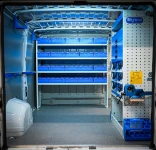
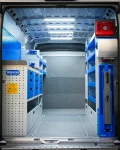
The two Fiat Ducatos seen here differ in size. The first is a relatively compact L2 H1 variant. The second is a longer and taller L3 H2 variant. So how has the interior been organised?
Ducato 1
Racking has been installed on the right wall and the bulkhead. Both configurations occupy all available space in height and width.
The left wall is equipped only with cargo lashing systems and is otherwise free to accommodate large loads.
The floor is protected by a marble-look floor liner while the walls are protected by galvanised and painted steel panels.
Ducato 2
The left wall is equipped as a workshop area while the right wall serves as storage. The bulkhead is lined with marble-look plywood panels but otherwise free. The same material also forms the floor liner, into which grooves have been routed to accommodate rails and anchor points for securing cargo. The walls are protected by galvanised steel panels in this van too.
The left wall compared: accessories only vs. work area
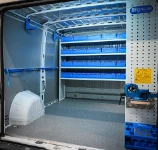
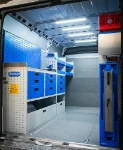
Let’s take a closer look these two plumbers’ Ducatos. On the left we have:
Ducato 1
The left wall of this van is lined but has no racking. A Syncroblock slider bar with hooks and lashing straps has been installed at half height and a second bar with adjustable, telescopic hooks has been installed at the top.
Ducato 2
The work area of this van consists of a generous workbench with raised sides and back. This is served by a fire extinguisher bracket and a large, perforated tool rack panel on the wall above it. The remainder of the racking in this configuration consists of two floor-level compartments with lift-and-rotate doors, two shelves, and nine metal drawers, all with non-slip mats and internal space dividers.
Two more shelves have been installed at the top of the forward section of wall, leaving a large compartment underneath for carrying tall items of equipment and cargo.
The right wall: is space or organisation best?
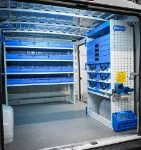
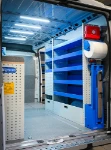
Ducato 2 is the larger variant of these two vans, and the difference is clearly noticeable on the right side where space is taken up by the sliding door. The clever organisation of the racking on the right of Ducato 1, however, compensates for this apparent disadvantage. Let’s take a closer look!
Ducato 1
The single column of racking in this van consists of an open floor compartment over the wheel arch, six pull-out trays for metal cases, four drawers and two shelves. A pull-out vice bench with a rotating metal vice extends from the rear side panel and a silicone tube rack with holes for nozzle can be seen just beneath it.
Ducato 2
This van boasts two columns of racking side by side, both standing on floor-level compartments partly enclosed by lift-and-rotate doors. Above are eight configurable shelves. The forward column also contains a drawer unit with drawers that open towards the side door. The side panel at the rear doors is equipped with a fold-away vice bench with an integrated support, a paper roll holder and a first aid kit.
The two Ducato bulkheads compared

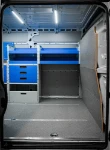
Ducato 1 is the only van in which racking has been installed at the bulkhead. The configuration consists of four specially adapted shelves with a total of 30 removable Euronorm containers.
Choosing the best solution for you!
This comparison between two Ducatos proves once again that there is no such thing as a standard Syncro racking system, only custom solutions for individual customers. Syncro has specialised in van racking since 1996 and has fitted out 100,000 vans in thirty years of activity. This wealth of experience and expertise is now at your disposal.
Don’t leave the organisation of your work to chance. Ask Syncro System to devise the best possible racking solution for your needs.