A MAN TGE FOR BOAT MAINTENANCE
A MAN TGE with Syncro racking for a marine maintenance firm
Objective 1: self-sufficiency in energy and logistics at the quayside
If you work in boat refitting and maintenance, you will know the quayside well. It’s a fascinating and scenic location, but logistically ruthless.
Working on a sailing yacht or motor cruiser requires total flexibility. You need to be able to diagnose electronic systems one minute and perform structural modifications on the deck the next. To offer a comprehensive service, your van needs to provide a work area with an autonomous power supply, all the tools, equipment and spares you might need, and all the lighting and cleaning accessories you would normally have at tour disposal back at base.
Objective 2: the separation of clean and dirty jobs
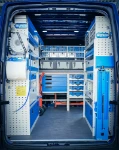
Contamination is a major problem when working inside and around boats. Fibreglass dust and engine oils cannot be allowed to foul the expensive materials found in the cabins or delicate engine control mechanisms. A van used to perform clean and dirty jobs must ensure a clear separation of functions, with a “dirty” heavy-duty area and a “clean” precision area in which tools and instruments are stored in closed containers and protected from dust, oil and dirt.
On this page we present a MAN TGE L3 H3 fitted out as a fully autonomous workshop for interior and external work on yachts and motor cruisers. An extensive and functional racking system has been installed, covering all three walls, and care has been taken to assign specific spaces to the different types of material carried.
How space is organised in this MAN TGE
Thanks to its generous dimensions (L3 H3), this MAN TGE provides all the space needed for a complete mobile workshop. The van came into our workshops with a floor liner already installed. Syncro supplemented this by protecting both the side walls with galvanized and painted steel lining panels.
Racking of different depths was then installed on all three surfaces.
Let’s take a closer look!
Room for everything on the left
Everything to hand and in perfect order. this objective is easy to achieve with Syncro System racking. Open and enclosed storage elements can be combined to cover all available surfaces exactly as needed.
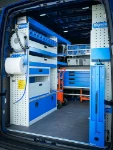
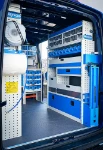
The racking on the left of this van is arranged in two columns, with the rear column serving as storage for tools and parts and the forward one carrying essential equipment for operational autonomy.
Column 1: storage
A floor-level compartment with a lift-up door supports a series of shelves, three of which are partly enclosed by lift-and-rotate doors. There is also an open shelf with plenty of space for tall items and a metal drawer. Further up again is a second open shelf, specially adapted for removable plastic containers. At the very top is a full-length tray for long items.
The practical paper roll holder is an essential addition on this side, as indeed is the hose reel for delivering compressed air wherever it is needed.
Column 2: operational autonomy
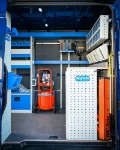
The column of racking towards the front of the van contains just one shelf which divides the space into two parts. The bottom section houses the van’s compressor while the top houses an Ecoflow Delta 2 power station mounted on dedicated brackets, and an Alternator Charger.
Thanks to the addition of this powerful, portable, electrical power station and the strip of power sockets associated with it, the van’s marine mechanics do not have to waste time searching for an electrical post in the marina but can enjoy the same stability as a land-based power source directly at the quayside.
The right wall: to be really useful, space has to be neat
The right wall is organised in a way quite similar to column 1 on the left. There are, however, some key differences.
The enclosed compartment at floor level supports two sealed, stainless-steel trays for transporting jerry cans, one in a wide, low compartment, the other in a narrow, tall one. Both trays are equipped with lift-and-rotate doors to improve security under heavy braking or on sharp turns.
Further up is a metal drawer, a shelf with a door, a shelf of removable blue boxes, a MultiBox cabinet with 12 removable transparent drawers and finally another shelf at the top.
The rear-facing side panel has been fitted with three essential accessories: a fold-away vice bench complete with metal vice, a storage pocket and a spray can rack.
Where’s the work area? On the bulkhead. There’s a clever trick here too!
The well-equipped work area is located on the bulkhead and comprises:
- a workbench in resin-coated marine plywood, with a strip of power sockets at the side
- four metal drawers with non-slip mats and internal space dividers
- four pull-out trays for metal tool cases
On the wall behind are:
- three document pockets
- a MultiBox cabinet with 10 removable, tilting transparent drawers
Note the gap purposefully left between the workbench and the bulkhead to stow a folding ladder, which can be removed easily from the side door.
For tailor-made excellence, you can rely on the experts!
No two jobs in the marine industry are the same, and no two Syncro-equipped vans are identical either. This MAN TGE clearly demonstrates how a “tailor-made” racking solution from Syncro System can transform any van into mobile workshop capable of serving the needs of those who use it daily.
Want to work better and save time and money? You can rely on the van racking specialists. Contact us now for a no-obligation consultation!