A COMPARISON OF TWO TRANSPORTERS TRANSFORMED BY SYNCRO
Two Transporter solutions compared
Racking vs. liners: the choice depends on the purpose!
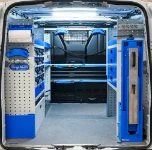
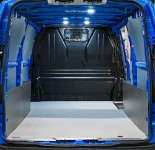
On this page we compare two very different solutions for the same van, the Volkswagen Transporter.
The first vehicle is an L2 H1 variant owned by a business that services industrial machinery. The second is an L1 H1 operated by a removals company.
Since the requirements are diametrically opposite, the chosen solutions are too.
Above all, Transporter (1) required a well-organised racking system in which every tool has its own place, and where everything can be stowed in a secure but easily accessible manner to save the user time in his daily work. The solution assumes the form of a storage system that is highly structured though not particularly flexible, with racking on both sides and cargo retaining accessories on the bulkhead.
The priority for Transporter (2) was versatility. Maximum floor space was needed, along with lashing systems to stop cargo sliding around and sustaining damage during transport. Apart from the liners, the resulting configuration consists only of two metal side pockets and three Syncroblock bars with lashing straps. This simple system, however, is perfect for the user, who needs to transport different loads every day. This arrangement leaves it up to the user to ensure order. Cargo must be loaded in the most rational way and the two side pockets utilised to avoid losing small objects and tools.
With or without liners: what changes?
Both Transporters are fitted with interior liners, but different solutions have been chosen depending on the presence of racking. Liners primarily serve to protect the vehicle’s original bodywork and to reinforce the interior to prevent dents, scratches and rust. If racking is installed, however, liners also serve another purpose, as anchorage for the various modules, so that holes do not need to be drilled in the original bodywork.
The floor liner in Transporter (1) is made from plywood with a marble-look surface and stainless-steel edge profiles. That in Transporter (2) is also made of plywood but has a rubber-coated surface for maximum grip.
The sides of both vans are lined with galvanised and painted panels finished in an elegant grey, but these reach all the way up to the roof only in the second van. The same type of panelling protects the bottom part of the doors.
Other lining solutions for the Transporter
Equipment on the left of the Transporters
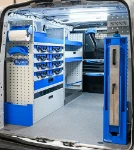
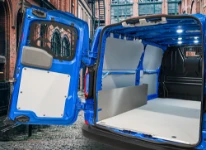
Now let’s see how these two vans are fitted out. The difference is plain to see in the choice of racking and accessories for the two side walls.
Transporter (1). The left wall is entirely occupied by racking, consisting of:
- a floor-level compartment with a lift-and-rotate door
- a sealed tray for the transport of liquids, complete with bottom grille and a lashing strap at the front
- one drawer and four pull-out trays containing a total of 8 metal cases
- three shelves including one with a lift-and-rotate door and two only with non-slip mats and space dividers
- a cable holder, a metal storage pocket and a paper roll holder
Transporter (2). In this van, the left wall is almost completely free, with the exception of a large side pocket in stainless steel and two Syncroblock bars with hooks and straps.
Equipment on the right of the Transporters: racking vs. accessories
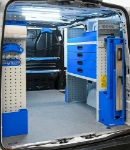
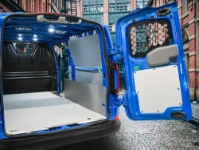
Transporter (1). The right side of this van is equipped with a single column of racking consisting of an open floor-level compartment over the wheel arch, four drawers with non-slip mats and space dividers, and a shelf at the top. A fold-away vice bench complete with integrated support and metal vice is fixed to the rear-facing side panel. This can be used as a table for a PC or for compiling forms, or as a practical work surface, thanks to a multi-socket for electrical power fixed to the top of the racking.
Transporter (2). In this van, the right side is configured exactly like the left, with a large stainless-steel pocket and a Syncroblock bar with hooks and strap.
Different choices for the bulkheads of the Transporters
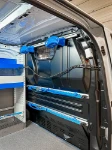
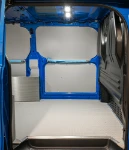
The bulkhead of Transporter (1) is equipped with a number of cargo retaining accessories to make this part of the van perfect for carrying large loads. In particular, it is equipped with three Syncroblock bars. The one at the top is fitted with two cable holders while the other two are fitted with hooks and lashing straps. A robust, black elastic strap with H-shaped links is attached to fittings about halfway up the bulkhead.
The bulkhead of Transporter (2) has been left untouch
What do you need for your own van? Discuss your requirements with the experts in van racking
Racking = permanent organisation and protection
Free walls = total flexibility and maximum payload
Which if these options suits you best? Syncro can design a tailor-made solution to satisfy all your requirements.
The right solution depends entirely on what type of job you do and what your working priorities are! Contact Syncro System today to book a non-binding consultation with our experts. We have solutions for problems you have never even imagined!