A COMPARISON OF TWO CUSTOM RACKING SYSTEMS
Two Custom racking solutions compared
How do you equip a van to do a specific job?
Imagine that you own a company that specialises in cleaning solar panels and that your schedule for the coming week starts with cleaning a small residential array of photovoltaic panels, but after that you have to clean a large industrial solar park. The two jobs require very different equipment: short rods and manual brushes for the one, long rods and powered systems for the other.
Then imagine running a small construction company and having to tile a small bathroom first and then renovate an entire apartment, carrying with you everything you need for the job.
If your van has racking on both walls, it would be impossible for you to cope with the continuous changes of cargo. You would almost certainly end up leaving things in a pile on the floor, defeating the objective of tidiness you set yourself when you invested in a racking system.
Businesses like these and so many others need a different approach based on free space and flexibility. This is illustrated by the two Ford Custom vans seen on this page.
The secret to flexibility
The secret is … functional asymmetry! This sounds complicated but is actually a very simple situation: one half of the van is equipped as storage while the other half is left free to adapt to the job in hand. On one wall you carry everything you need regularly, neatly arranged in dedicated containers and accessories.
On the other wall, there’s virtually nothing to get in the way apart from liner panels and lashing systems. This area provides variable, super-flexible cargo space that is easy to access for loading and unloading alike. The bulkhead remains free too, so that cargo can be moved around and arranged without obstacles or constraints.
This type of configuration is ideal when:
- your work regularly requires different equipment
- you need to load and unload bulky items quickly and easily
- you want to keep a large cargo area free from racking
It’s not so good if:
- you regularly use lots of different tools and components
- you need a large, easily accessible work area
- you want to keep less of your cargo on view
The Custom’s free wall: when space is needed
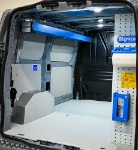
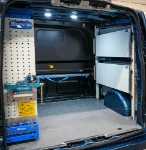
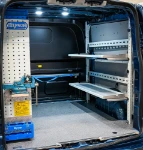
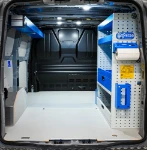
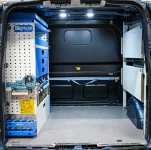
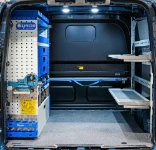
The two Custom vans compared on this page are an L1 H1 variant owned by a company that specialises in cleaning photovoltaic panels, and an L2 H1 crew cab variant owned by a construction company. Both vans have racking only on one side while the other has been equipped to transport bulky loads on the floor.
Custom 1
In this Custom the left wall is almost completely free ready to accommodate loads of all types and sizes.
To ensure maximum flexibility, the wall has been left without equipment at the bottom and centre, while a full-length top tray with an access door at the rear has been installed at the top to carry long objects. This type of tray is ideal for transporting rods, brushes and pipes without having to install a roof rack and pipe carrier. Its position leaves most of the wall free.
The van’s floor is protected by a floor liner made from 9 mm thick plywood. The vertical surface of the wheel arch liner is also made from this material while the top panel is made from shaped metal sheet. Protecting the bodywork is essential to prevent dents and cuts, especially when cargo has to be loaded and unloaded frequently.
Custom 2
In this van, the right wall has been left free to secure cargo, but has the advantage of being equipped with two folding shelves. When closed these take up almost no room. When open, they transform the wall into practical open shelving, on which cargo can be secured by means of hooks and straps. In this van the floor is covered with a resin-coated marine plywood floor liner with metal edge profiles, while the walls retain their original panelling.
Other racking solutions for the Custom
The Custom’s mobile warehouse: everything always to hand
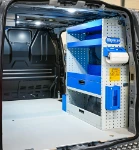
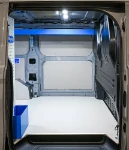
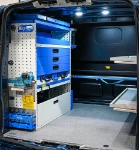
Let us now see how the racking has been configured, on the right in the first van, on the left in the second.
Custom 1
The racking in this van consists of a floor-level compartment partly enclosed by a patented lift-and-rotate door, one drawer and three shelves, all with non-slip bottom mats, internal space dividers and raised back panels to prevent items falling down behind. Two useful accessories have been added to the rear-facing side panel: a glove holder and a paper roll holder. The corresponding panel at the side door is equipped with a metal storage pocket.
Custom 2
In this van the racking comprises a floor-level compartment with a lift-and-rotate door, one pull-out tray with two metal cases, three drawers, a configurable shelf and, at the very top, a shelf of removable plastic containers.
Between the first and second levels of racking, Syncro has installed a pull-out vice bench recovered from an old racking system belonging to the customer. The space left between the racking and the bulkhead is equipped with a bracket that supports a custom-made shelf carrying an Ecoflow power station. A bar rack with lashing strap has been added at floor level. Finally, on the rear-facing side panel is a spray can rack, mounted on a panel of aluminium chequer plate to protect the racking against dents and scratches.
Though without racking, the bulkhead in Custom 2 is equipped with a Syncroblock bar with hooks and lashing straps.
Want a fully customised racking system for your own van? Syncro transforms your van to match your job and your working habits! Don’t put it off! There’s a free consultation waiting for you!