A COMPARISON OF SYNCRO RACKING IN TWO MERCEDES SPRINTER VANS
Two Syncro racking systems in the Sprinter
Two racking solutions compared: Sprinter vs. Sprinter
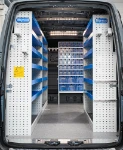
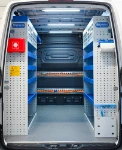
This page presents a comparison of two Syncro racking systems installed in identical vans, both used for technical assistance, but in different sectors. Both vans are Mercedes Sprinter L2 H2 variants. Van 1 is used for installing and servicing lifting equipment while van 2 is used for servicing painting systems. ùThe two racking systems are configured in a similar way, with a large number of shelves installed on both sides of the van. The main difference lies in the way the bulkhead is used. In the first van, this is occupied by a third column of racking. In the second, it is fitted only with cargo lashing accessories.
Let’s take a closer look, starting with the liners.
Other Syncro racking solutions for the Sprinter
Liners… the starting point for any racking system
There is unanimous consensus on the importance of liners for all working vans. Liners preserve the bodywork by protecting it against wear and tear and accidents during loading and unloading, preventing dents and scratches and the rust that inevitably follows. Of course, each customer has different needs and preferences when it comes to deciding how best to line the interior of their van.
Van 1: In this Sprinter, the floor liner is made from marble-look plywood with stainless steel edge profiles and anchor ring cups. The panelling on the walls is made from painted steel sheet. The bulkhead has been left uncovered but is partially protected by the column of racking.
Van 2: The floor liner is made from marble-look plywood in the second Sprinter too, but this time the walls are lined with Peraluman aluminium panels. The bulkhead has again been left without liners despite the absence of racking to protect it.
Other lining solutions for the Sprinter
The left of the Sprinter L2 H2
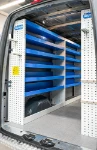
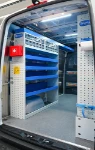
The racking configurations on the left of these two Mercedes Sprinter vans is quite similar. Both solutions feature an abundance of configurable shelves, with non-slip bottom mats, internal space dividers, and raised back panels to stop objects falling down behind. There are differences, however.
Van 1: The wall is fully occupied in height and length by two columns of racking, providing a total of 12 identical shelves. The floor-level compartments are delimited by bottom profiles at the front but have no doors as such. Two telescopic hooks have been fixed to the rear side panel.
Van 2: The wall is divided into two sections. The area closest to the rear doors starts with a floor-level compartment with a bottom profile. Above are four shelves, followed by MultiBox cabinets of pull-out transparent containers, six large and twelve small. The section of wall at the front has been left free for carrying large loads. A top tray for long objects runs the full length of the wall.
A first aid kit has been fixed to the rear side panel.
The racking on the right of the Sprinter L2 H2
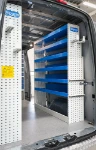
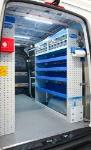
The right of the two Sprinters described on this page repeats a similar pattern to that seen on the left. Available space on this side is obviously limited by the presence of the sliding door.
Van 1: The right wall is completely occupied by a column comprising a floor-level compartment and six configurable shelves. The side panel accessible through the side door is fitted with a soap dispenser and a handwash kit consisting of a water tank with tap held in a dedicated frame by a lashing strap. The rear side panel is equipped with two additional telescopic hooks and two magnetic tool bars.
Van 2: The floor-level compartment and four shelves are complemented, at the top, by MultiBox cabinets providing a total of 18 pull-out containers, and by a top shelf. The side panel at the rear doors is equipped with a bar rack with metal flange and lashing strap and a paper roll holder.
How to use the Sprinter’s bulkhead most effectively: two different approaches
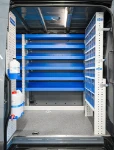
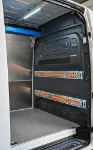
When it comes to deciding whether to install racking on the bulkhead or not, you should always ask yourself two questions. Have I already got enough storage in the van to carry everything I need? Will I ever need the extra floor space to carry bulky equipment or material? The owners of these two Sprinters gave two different answers.
Van 1: The bulkhead is equipped with MultiBox cabinets of tilting transparent containers totalling 42 in number, in different sizes. The customer intends to use these to carry tools, spares and small parts separately, and to keep his stock under control. This solution is a great way of compensating for the lack of enclosed storage on the side walls and satisfies a need that the owner prioritises over the ability to carry large loads.
Van 2: Here the opposite decision was made. Satisfied with the availability of open and enclosed storage on the two sides, this customer preferred to equip the bulkhead with two heavy duty ROTM rails and lashing straps.
Space in the cargo compartment is identical but the possible interpretations are almost infinite!
This comparison shows that even when the available space is identical, finished racking solutions are likely to be very different. The work of tradesmen and professionals is subject to too many variables and preferences, and the Syncro catalogue offers customers such a vast range of choices…
The choice and positioning of accessories can also change outcomes radically. For example, additional lights have been installed in both Sprinters, but in the first van only one powerful LED light bar has been positioned in the centre of the roof while in the second van LED tube lights have been fitted to three roof cross-members to provide more uniform illumination.
Still in doubt? Request an obligation-free consultation with Syncro – the specialists in van transformation!